
Quick Answer
A pedestrian hit in North Carolina can bring a claim, but where you crossed shapes it. Drivers yield at crosswalks. Elsewhere you yield, though every driver still owes due care.
The real danger is contributory negligence. If the insurer proves you were careless at all, you recover nothing. G.S. 1-139 makes the defense prove it. Even the crosswalk settles little, because turning drivers still hit people inside the lines. Last clear chance can save a claim when the driver had time to avoid you and did not.
Key Takeaways
- Why does the vehicle that hit you matter in a North Carolina pedestrian claim?
- Does being in the right place make a pedestrian claim simple?
- Who has the right of way when you cross a street in North Carolina?
- Can your claim survive if the insurer says you crossed in the wrong place?
- What should a North Carolina pedestrian do before the insurer calls?
- What else do people ask about being hit by a car while walking in North Carolina?
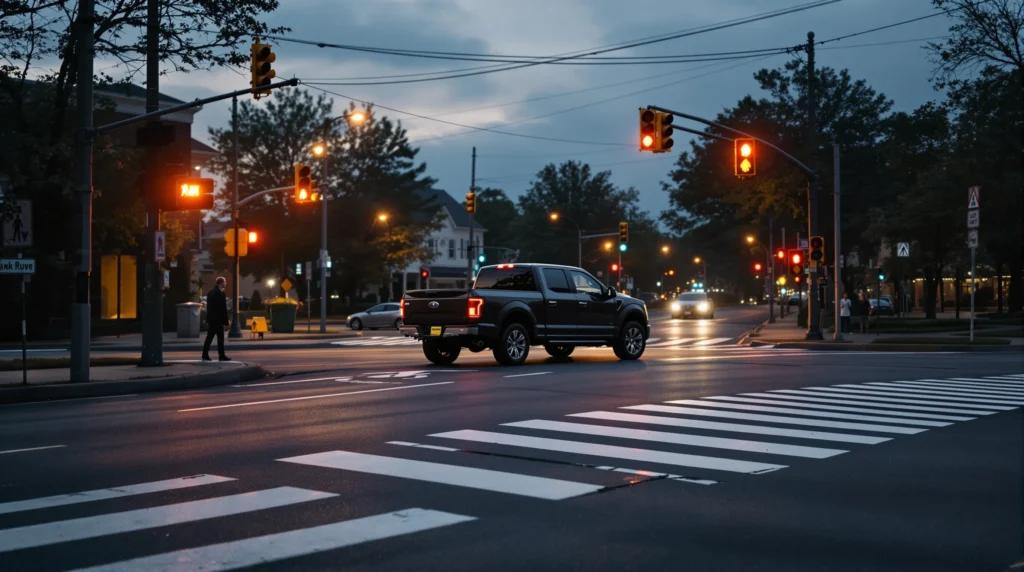

In 2024, 281 pedestrians were killed in motor vehicle crashes in North Carolina, a 12% increase from 2023, according to NCDOT’s Traffic Crash Facts. Many more were hurt and went home to a police report number and a stack of mail.
North Carolina makes those claims harder than most states do, because the state still follows contributory negligence. Before an adjuster calls, ask yourself one question: where exactly were my feet when the car came? A driver’s apology at the scene does not stop that argument.
I wrote this for the person who is sore, holding a police report number and a growing stack of mail, and wondering whether crossing in the wrong spot sank the claim. It covers what G.S. 20-173(a) and G.S. 20-174 say about who yields where, and why the duty of due care in G.S. 20-174(e) binds every driver anyway. It explains how G.S. 1-139 puts the burden of proving your carelessness on the defense, and how last clear chance can carry a claim the insurer calls dead. It also sorts out which insurance pays first, including your own uninsured motorist coverage when the driver flees.
There is a table of crossing spots and the argument the insurer will make about each one. There is a list of what to do after you are hit. Start with the vehicle. Its shape tells me where the fight will be.
North Carolina is one of only a handful of states where a pedestrian partly at fault can recover nothing. Here, a pedestrian who crossed in the wrong place does not lose part of the claim. The claim can be lost entirely. So get the names of anyone who saw you step off the curb.
The fear shows up early. People worry that something innocent they say to an adjuster will be used to deny the claim. That worry is well placed.
I am a Charlotte injury lawyer. I want you to know three things before you talk to anyone. Write down where you stepped off the curb, today. Do not guess at speeds or distances when the adjuster asks. And the kind of vehicle, and the turn it was making, changes what the insurer will try to say about you.
This article answers three questions:


Why does the vehicle that hit you matter in a North Carolina pedestrian claim?
The vehicle shapes the injury, and the injury shapes the claim. With $122 million in recovery on the Brown Moore side, I want to know first what struck you.
Before an adjuster calls, write down four things while they are fresh:
- The kind of vehicle: car, SUV, pickup or minivan.
- What it was doing: turning left, turning right, or going straight.
- Where you stood: in a crosswalk, at an intersection, or along the edge of the road.
- The time of day and the light.
In March 2022, the Insurance Institute for Highway Safety released a study built on North Carolina’s own records. Researchers pulled every police-reported pedestrian crash in the state from 2010 through 2018. In that 2022 study, pickups were 42% more likely than cars to hit a pedestrian on a left turn. The 2022 study found SUVs were 23% more likely. Right turns showed no significant difference by vehicle type.
Away from intersections the gap grew. The 2022 study found pickups were 80% more likely than cars to hit someone walking or running along the road, SUVs 61%, and minivans and vans 45%. The study also found larger vehicles more often involved where a person was standing, walking or running near the road’s edge.
The study’s authors pointed to the A-pillars. Trucks and SUVs carry thicker roof pillars because of federal roof-strength standards, and those pillars can hide a person near the corner of the windshield. In 2021, a Consumer Reports analysis of industry data from 2000 to 2018 found passenger trucks 11% taller and 24% heavier. The authors were careful to say more study was needed before blaming those blind spots for the rise in deaths.
A left turn is a yielding moment. A tall hood pushes the driver’s eyes further down the road. Put those together and the person in the crosswalk is the one nobody saw.
The common assumption is that a car is a car. The North Carolina numbers say otherwise, and the difference shows up in the medical file. The person on foot takes the whole blow, first from the vehicle and then from the pavement.
Weight and height decide how far a body travels and how hard it lands. When that landing finds an old back or knee problem, the claim changes again, and I walk through that in my piece on when a car accident aggravates a pre-existing condition.
Size tells you how bad. It does not tell you who pays.
Does being in the right place make a pedestrian claim simple?
No. Right of way is where the argument starts, not where it ends. Brown Moore’s attorneys bring more than four decades of collective North Carolina personal injury practice to that argument.
Conventional wisdom says the person on the sidewalk or in the crosswalk has nothing to prove. The record says different.
Take North Tryon Street. Just before 1 a.m. on Saturday, July 5, 2025, a 74-year-old man was walking on a sidewalk in the 4300 block, near East Sugar Creek Road. Two vehicles collided. One of them left the road and struck him. He died at the scene. The Charlotte Observer reported what police found: one heavily damaged car with a driver and two juvenile passengers, and a second vehicle, the one Charlotte-Mecklenburg police said caused the collision, already gone. The driver who stayed was charged with driving while impaired. Investigators did not say which vehicle hit the man. CMPD said, “It is unknown if speed or impairment are factors for this collision for the vehicle that caused the collision.”
He was on a sidewalk. Nobody will argue he lacked the right of way. His family still faces two drivers, one missing, one charged, and no public word on whose bumper did the damage.
Now take a crosswalk. Picture the walk signal lit and a driver turning right who hits you inside the painted lines, then asks if you are okay. In shock, you say you are fine, and the driver leaves. No plate. No name. The pain comes later, after the walk home.
Two people in the right place. Two claims with holes in them before the first doctor’s visit.
Fault is a separate question from right of way. A North Carolina injury lawyer said as much in a 2016 television segment: pedestrians have the right of way, but that does not make the motorist automatically at fault. Pedestrians have to follow the law too. The same lawyer said a pedestrian who breaks it is contributorily negligent and has no claim for damages. That overstates it a little, as the court cases below show, but the risk is real.
That last part is the North Carolina problem. In most states, a pedestrian partly at fault still recovers something. Here, under contributory negligence, a small share of fault can close the file. I cover the basics of the process in how personal injury claims work in North Carolina, but pedestrian cases put more weight on one fact than most. That is why our pedestrian accident lawyers start with where you crossed.
The insurer will want to know exactly where you stood, what the signal said, and which way you looked. Those questions have answers in the statutes, and the answers depend on where you crossed.
Who has the right of way when you cross a street in North Carolina?
Drivers must yield to pedestrians in crosswalks at intersections. Pedestrians crossing anywhere else must yield to cars. Every driver still owes due care to everyone on foot.
WCNC put it bluntly in a 2023 VERIFY report: people on foot do not always have the right of way, though drivers must yield to them in certain places. The same report noted that a pedestrian who fails to yield when required can be ticketed.
The statutes sort the street into zones. Here is how they line up against the argument you will hear from the other side.
The table in the next section lays out each zone, the statute behind it and the argument an insurer is likely to make.
One rule sits over every zone. Under G.S. 20-174(e), notwithstanding the rest, every driver must use due care to avoid colliding with any pedestrian. The driver must take proper precaution on seeing a child or a confused person in the road.
North Carolina’s courts have drawn the lines in real cases. In Culler v. Hamlett, 148 N.C. App. 372 (2002), the Court of Appeals said “a plaintiff’s failure to yield a right-of-way in violation of N.C.G.S. § 20-174(a) is not contributory negligence per se.” It added, quoting an earlier case, that it “may be contributory negligence as a matter of law.” The pedestrian in that case, crossing a dark, foggy road back to her stalled car, lost.
Two more doors stay open. Contributory negligence is a defense, and G.S. 1-139 puts the burden of proving it on the defense. The insurer has to prove your fault; you do not have to disprove it. And last clear chance can keep a claim alive when the pedestrian was careless but the driver could still have avoided the crash. In VanCamp v. Burgner, 328 N.C. 495 (1991), the North Carolina Supreme Court let a pedestrian who crossed with no crosswalk or signal take last clear chance to a jury. The court listed four things the pedestrian must show: that the pedestrian “negligently placed himself in a position of peril from which he could not escape by the exercise of reasonable care,” that the driver knew or could have discovered that peril, that the driver “had the time and means to avoid injury,” and that the driver “negligently failed to use the available time and means to avoid injury.”
Which way you faced can matter. In Nealy v. Green, 139 N.C. App. 500 (2000), a man walking along a rural road with his back to traffic was struck by a truck’s mirror, and the Court of Appeals ordered a new trial because the jury should have heard last clear chance. The court noted that cases “have consistently distinguished between situations in which the injured pedestrian was facing oncoming traffic and those in which the pedestrian was not.”
Nobody publishes how often an insurer wins the crossing argument. I can’t give you that number, and I won’t guess at one. What I can tell you is that the fight is over facts, and facts fade.
Your own policy may cover you on foot. Under G.S. 20-279.21, uninsured motorist coverage protects the named insured and relatives living in the same household “while in a motor vehicle or otherwise.” That “or otherwise” reaches a family member hit while walking. Medical payments coverage depends on your policy’s wording, so read it before you assume.
The bills will not wait for the investigation. Hospitals ask for the at-fault driver’s information early. A health insurer that pays first will want its money back from any settlement. And once you sign a release, there is no going back for more. I explain how a health insurer gets paid back from a settlement in this guide.
So the first question is where you stood. The second is who will pay while the insurer argues about it.
Can your claim survive if the insurer says you crossed in the wrong place?
A Charlotte television fact check once told viewers that pedestrians at an unmarked crosswalk lack the right of way. North Carolina’s statute says something different, and here small misreadings carry unusual weight.
In April 2023, the VERIFY team at WCNC in Charlotte rightly said pedestrians do not always have the right of way, then added that anyone crossing without a crosswalk or at an unmarked one does “not have the right of way.”
The statute disagrees. Where signals “are not in place or in operation,” G.S. 20-173(a) makes drivers yield to a pedestrian “within any marked crosswalk or within any unmarked crosswalk at or near an intersection.” Under G.S. 20-174(a), pedestrians must yield only when they cross outside both kinds.
One misread rule matters because of what follows. Breaking a crossing rule is not automatically contributory negligence, but on clear facts a judge can rule that it was.
Where you stood gives the insurer its opening argument, starting with the timing of the walk signal.
| Where you were | Who must yield | Rule | What an insurer is likely to press |
|---|---|---|---|
| Marked crosswalk, “walk” signal | Driver | G.S. 20-172(b) | When you stepped off the curb |
| Marked crosswalk, “don’t walk” signal | Pedestrian may not start to cross | G.S. 20-172(b) | Your signal violation, against the driver’s due care duty |
| Marked or unmarked crosswalk at or near an intersection, no working signal | Driver | G.S. 20-173(a) | Whether the spot counts as “at or near an intersection” |
| Mid-block between two working signals | Pedestrian may cross only in a marked crosswalk | G.S. 20-174(c) | Whether a marked crosswalk existed there |
| Anywhere else outside a crosswalk | Pedestrian | G.S. 20-174(a) | Lighting, visibility and the driver’s lookout |
| Along a road with no sidewalk | Pedestrian, walking on the left facing traffic | G.S. 20-174(d) | Which side of the road you were on |
| Sidewalk across a driveway or business entrance | Driver entering or leaving | G.S. 20-173(c) | Whether you were on the walkway |
None of those rows settles a case, in either direction. G.S. 20-174 ends with a clause that applies “notwithstanding the provisions of this section”: every driver “shall exercise due care to avoid colliding with any pedestrian upon any roadway.”
Once both sides have a rule, the argument moves to facts: where the point of impact was, what the driver could see, and whether the driver kept a proper lookout. Camera footage, witness statements and the driver’s own account of when they first saw you settle those questions.
North Carolina crash records suggest where the lookout question may count most. Studying police-reported pedestrian crashes in the state from 2010 through 2018, the Insurance Institute for Highway Safety, a research group funded by auto insurers, found the widest gaps between larger vehicles and cars away from intersections, where people were walking or running along the road.
The researchers suggested wider roof pillars may hide pedestrians near a vehicle’s corners, though they said more study is needed to prove the link.
Sometimes the crossing never comes up, as for the man killed on the North Tryon Street sidewalk. When the driver who caused a crash is gone, the claim may run through uninsured motorist coverage, the subject of our page on hit and run crashes.
Where you stood decides who should have yielded, and it gives a North Carolina insurer its best case for paying nothing. The reply sits in the same statute: a due care duty that follows the driver onto every stretch of road. Away from intersections, the crash data make what the driver could see a fair question. Your crossing opens the argument. Proof about the driver’s lookout keeps the claim alive.
Five checks when your crossing is disputed
- Pin down the exact spot and whether the signals were working: painted crosswalk, unmarked corner, mid-block between two signals, or roadside.
- If an adjuster says you crossed illegally, ask which statute and subsection the claim rests on.
- Look early for video from nearby businesses, and write down every witness name.
- Note the type of vehicle that hit you, and ask whether its hood height or roof pillars could have limited what the driver saw.
- Ask your own auto insurer whether your medical payments or uninsured motorist coverage applies when you are hit on foot, including by a driver who fled.
How we checked this
We read the current text of G.S. 20-172, 20-173 and 20-174 on October 21, 2026, and checked it against a 2023 Charlotte TV fact check. We also used the Insurance Institute for Highway Safety’s 2022 release on its North Carolina pedestrian crash study, a Charlotte Observer crash report and a 2016 television interview with a North Carolina injury lawyer. No figures here come from our firm. The crash study covers police-reported crashes from 2010 to 2018. It shows relative odds and cannot show causes. Like that lawyer, we earn our living representing injured people, so we have a stake in how these rules are read.
- North Carolina General Assembly, G.S. 20-173 on crosswalk right of way, read October 21, 2026.
- North Carolina General Assembly, G.S. 20-174 on crossing outside crosswalks, read October 21, 2026.
- WCNC VERIFY, fact check on pedestrian right of way, April 2023.
- Insurance Institute for Highway Safety, release on its North Carolina pedestrian crash study, March 2022.
- Charlotte Observer, report on a North Tryon Street sidewalk death, July 2025.
- A North Carolina personal injury lawyer, television segment on state pedestrian law, October 2016.
- North Carolina General Assembly, G.S. 20-172 on pedestrian control signals, read October 21, 2026.
Hit while walking in Charlotte? Talk to a lawyer before the insurer sets the story.
Shock makes people say they are fine. Adjusters write that down. Brown Moore’s Charlotte personal injury lawyers will review where you crossed, what the driver owed you, and which policy pays. The consultation is free.
Book your free consultation
What should a North Carolina pedestrian do before the insurer calls?
Write down where you crossed, what the signal showed and what the driver did. Then let a lawyer read those facts before anyone records your statement.
The streets are getting more crowded. WCNC reported in 2023 that more cars and new sidewalks across Charlotte were already causing confusion over who has the right of way. That confusion is what the insurer works with.
I don’t treat the crosswalk as a safe harbor. A driver turning right on red can still put you on the hood while you stand inside the painted lines. What carries the claim is proof: the signal, the spot, the driver’s turn. Take the photos. Keep the shoes. If your health plan has a high deductible, it matters which insurer pays first, so ask that question before you sign anything the adjuster mails you.
One more line to draw. If you were hurt by a broken sidewalk or a fall rather than a car, that is a premises claim against the property owner, and our guide to North Carolina slip and fall claims covers how those work.
Summarize This Article With AI
Open this article in your preferred AI engine for an instant summary.
What else do people ask about being hit by a car while walking in North Carolina?
Most questions come back to three things: where you crossed, whether the driver used due care, and which insurance pays. The answers below take them one at a time.
No. Under G.S. 20-173(a), drivers must yield to pedestrians in marked crosswalks and in unmarked crosswalks at intersections where signals are not operating. Away from those spots, G.S. 20-174(a) puts the duty to yield on the person walking. One duty never shifts. Under G.S. 20-174(e), every driver must use due care, the ordinary caution needed to avoid hitting anyone on foot.
Sometimes. Crossing mid-block hands the insurer its best argument, and between signalized intersections G.S. 20-174(c) says to cross only in a marked crosswalk. But the driver’s duty of due care still applies. A driver who was speeding, looking at a phone or ignoring a person plainly in the road can still be held responsible.
Contributory negligence is the rule that a person whose own carelessness helped cause the injury recovers nothing. North Carolina still follows it. Under G.S. 1-139, the defense carries the burden of proving it. The insurer has to prove you were careless. You do not have to prove you were careful.
Last clear chance is the answer to contributory negligence. If you put yourself in danger but the driver saw you, or should have, and had time to avoid you, the driver’s failure can carry the claim anyway. It is fact heavy. Speed, distance, lighting and sight lines decide it, which is why I want the scene photographed early.
Often, yes. Uninsured motorist coverage pays when the driver at fault has no insurance or cannot be found. Under G.S. 20-279.21, it protects the named insured and relatives living in the same household “while in a motor vehicle or otherwise,” which reaches you on foot. Medical payments coverage depends on your policy’s wording. Pull the declarations page and the UM section and bring both to a consultation.
Call 911 and give police everything you saw: the car’s color, its direction and any part of the plate. Leaving the scene does not end your claim. If the driver is never found, your own uninsured motorist coverage may be where the claim goes next. Our page on hit and run crashes explains how that works.
At first, often your health insurance or your own medical payments coverage. The order in which insurers pay affects what comes out of your pocket and what comes back to them later, so sort it out before you settle.
• Call 911 and ask for a police report.
• Get medical treatment the same day, even if you feel fine.
• Photograph the crossing: the crosswalk paint, the curb and where you landed.
• Photograph the signals and the lighting, at the same hour if you have to go back.
• Take the names and numbers of witnesses.
• Write down the car’s plate.
• Keep your shoes and clothing. Do not wash them.
The insurer may try. The statute pushes back. G.S. 20-174(e) requires every driver to take proper precaution on seeing a child or a person who appears confused in the road. A driver who saw a child near the curb and kept the same speed has a hard question to answer.
Brown Moore & Associates, PLLC is a Charlotte personal injury firm representing people hurt by another party’s negligence across North Carolina and South Carolina. The consultation is free. Reach the firm through its contact page, and bring the police report number with you.

Matthew Berthold represents victims and their families throughout all of North Carolina, litigating cases both large and small. He is passionate about fighting for every client to ensure that they are treated fairly, with respect, and to obtain the best possible outcome.

