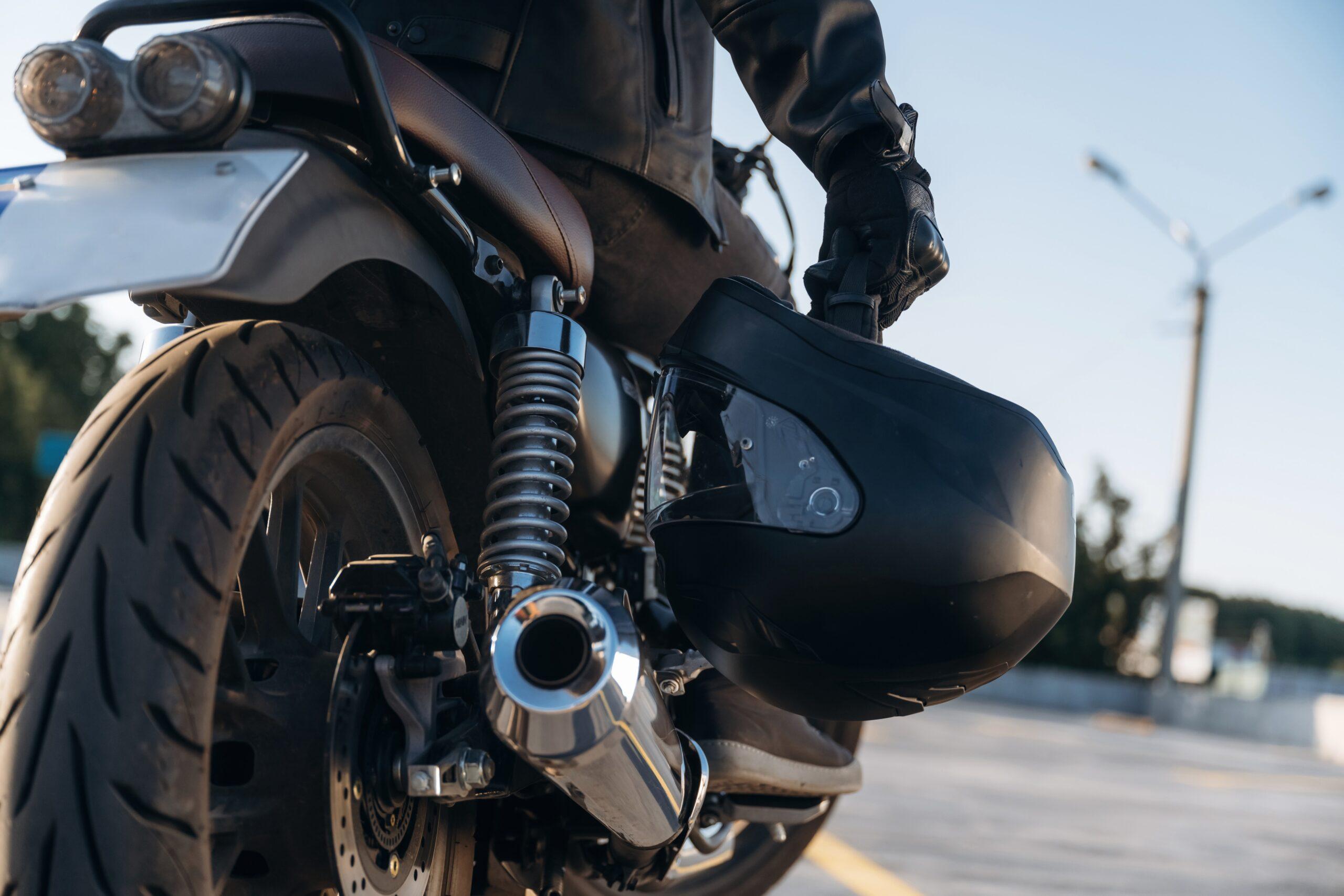

North Carolina requires motorcycle riders and passengers to wear approved helmets. But violating the helmet law does not automatically make an injured rider at fault for a crash, nor does it automatically prevent that rider from pursuing compensation.
That distinction matters in North Carolina, where contributory negligence can bar recovery if an injured person’s own negligence contributed to the accident. After a motorcycle crash, insurers may still focus heavily on helmet use, particularly when the rider suffered a head or brain injury.
At Brown Moore & Associates, PLLC, our Charlotte motorcycle accident attorneys examine the helmet issue in the context of the entire case: who caused the collision, what injuries resulted, what the medical evidence shows, and whether the insurer is trying to shift responsibility away from the driver who caused the crash.
What Does North Carolina Motorcycle Helmet Law Require?
North Carolina General Statutes § 20-140.4 requires motorcycle and moped operators and passengers to wear a safety helmet that complies with Federal Motor Vehicle Safety Standard 218. The retention strap must also be properly secured.
The requirement applies regardless of the rider’s age or experience. The statute provides a limited exception for certain autocycles with completely enclosed seating or a roll bar or roll cage.
Where Does North Carolina’s Helmet Law Apply?
N.C.G.S. § 20-140.4 applies to riders traveling on a “highway or public vehicular area.” North Carolina defines a “public vehicular area” very broadly; a rider doesn’t have to be traveling I-77 for the law to apply to them. The law includes bikers in parking lots and drives at stores, restaurants, office buildings, hospitals, schools, churches, and similar places open to public vehicle traffic.
Features of a Compliant Motorcycle Helmet
The North Carolina Division of Motor Vehicles identifies several features of a compliant helmet, including:
- A substantial inner liner, generally made of firm polystyrene foam
- A permanent DOT symbol placed on the helmet by the manufacturer
- A permanent manufacturer label identifying information such as the maker, model, size, date of manufacture, and materials
A violation is an infraction carrying a $25.50 penalty plus applicable court costs. The statute also provides that a helmet violation does not result in driver’s license points or an insurance surcharge.
Can You File an Injury Claim If You Were Not Wearing a Helmet?
Yes. N.C.G.S. § 20-140.4(b) specifically states that violating the motorcycle helmet statute is not negligence per se or contributory negligence per se in a civil action. An insurance company therefore cannot treat a helmet violation as automatic fault in a motorcycle accident claim.
That protection, however, does not necessarily make helmet use irrelevant. An insurer may still argue that wearing a helmet would have prevented or reduced a particular injury.
Whether that argument has merit depends on the injury, the mechanics of the crash, and the medical evidence. For example, a missing helmet has little obvious connection to injuries such as a torn shoulder, road rash, or a hip fracture.Those injuries result from the forces of the collision and the rider’s impact with the vehicle, pavement, or another object.
Catastrophic injuries and fatal accidents present different issues. When a rider suffers a traumatic brain injury, or if a rider succumbs to their injuries, an insurer may focus more heavily on whether helmet use affected the severity of the injury.
Wearing a DOT-compliant helmet can eliminate one potential argument about whether helmet use contributed to your injuries. We make sure that fact is clearly documented.
How Helmet Arguments Intersect With North Carolina’s Contributory Negligence Rule
North Carolina follows a pure contributory negligence rule. If an injured person’s own negligence contributed to the accident, even to a relatively small degree, recovery may be barred. That makes attempts to assign fault to the rider especially important.
After a motorcycle crash, an adjuster may ask about:
- Whether you were wearing a helmet
- Your speed before the collision
- Where you were positioned within the lane
- Whether you saw the other vehicle before impact
- Whether you could have avoided the crash
- Statements you made at the scene or during a recorded interview
The helmet statute limits one avenue of attack because a violation does not automatically establish contributory negligence. The central fault question remains how the crash occurred.
If another driver failed to yield, turned across the motorcycle’s path, changed lanes without checking, followed too closely, or disregarded a traffic signal, that conduct must be evaluated independently of whether the rider was wearing a helmet.
How Insurers Use Helmet Issues in Head and Brain Injury Claims
When a rider has a head or brain injury, the insurer may try to separate the cause of the crash from the cause or severity of the injury. For example, the carrier may accept that its driver caused the collision while still arguing that some portion of the rider’s damages resulted from not wearing an approved helmet.
That can become particularly significant when the claim includes:
- Long-term neurological treatment
- Cognitive or memory problems
- Lost earning capacity
- Rehabilitation
- Future medical care
- Assistance with daily activities
A generalized assertion that “a helmet would have prevented this” is not the same as proof. These disputes may require close examination of medical records, imaging, the location and nature of the impact, damage to the motorcycle and equipment, and the mechanism of injury.
At Brown, Moore & Associates, our attorneys build the claim around evidence of what actually happened rather than allowing an insurer to reduce a complex injury to a single fact.
Preserve Your Helmet After a Motorcycle Crash
If you were wearing a helmet, keep it exactly as it was after the collision.
Do not clean it, repair it, throw it away, or allow a tow yard or another party to dispose of it. Cracks, scrapes, compression, and impact marks can provide information about where the helmet was struck and the forces involved.
Photographs are useful, but the physical items themselves may become important evidence. In a serious case, an attorney or other qualified professional may need to inspect them.
Helmet evidence is only one part of a motorcycle accident claim. The broader investigation may determine whether you can establish fault and recover for the full extent of your injuries.
How Brown Moore & Associates Handles Charlotte Motorcycle Accident Claims
At Brown, Moore & Associates, we know that helmet issues are only one part of a claim. We will investigate the conduct that caused the collision. Depending on the case, that may involve reviewing police reports, photographs, witness accounts, vehicle damage, available video, roadway evidence, and other information that helps establish how the crash occurred.
We also document the injuries and their financial consequences. That includes medical treatment, lost income, limitations on work and daily life, future care needs, and other losses supported by the evidence.
If helmet use becomes an issue, we address it directly. We preserve the helmet and riding gear, examine whether the alleged connection to the injuries makes medical or factual sense, and challenge efforts to turn a helmet violation into fault for a crash caused by someone else.
We also review available motorcycle insurance coverage, including uninsured and underinsured motorist coverage when appropriate.
Partner Jon R. Moore and our team handle motorcycle and other serious motor vehicle cases from our Charlotte office. We maintain a manageable caseload so clients can work directly with an attorney, and when an injury makes travel difficult, we can arrange to meet with you.
Frequently Asked Questions About Motorcycle Laws in Charlotte
That does not necessarily mean you violated North Carolina’s helmet law. The statute requires the helmet to be worn with the retention strap properly secured, so the condition of the helmet, strap, and other gear may become important evidence. An insurer may still argue that the helmet was improperly secured or fitted, which is another reason to preserve it after the crash.
A police report is important evidence, but it is not necessarily the final word on what happened. Photographs, witness statements, helmet damage, body-camera footage, medical records, and other evidence may help show that you were wearing a helmet. If the report contains an error, an attorney can also evaluate whether the investigating agency has a process for correcting or supplementing it.
Yes. A helmet can sustain internal damage in a crash even when the outer shell appears intact. Manufacturers generally recommend replacing a helmet after a significant impact because the protective liner may have compressed and may not provide the same protection in another crash. If you are pursuing an injury claim, keep the damaged helmet as evidence and replace it for future riding rather than continuing to use it.
The applicable law can change when a Charlotte-area ride crosses the state line. South Carolina generally requires motorcycle helmets only for operators and passengers under age 21, while North Carolina requires them for riders of all ages. The state where the crash occurred may also affect other rules governing the claim. Brown Moore & Associates attorneys are licensed in both North Carolina and South Carolina and can evaluate which law applies.
Yes. North Carolina law permits motorcycles to operate up to two abreast in a single lane. Motorcycles are otherwise entitled to full use of a lane, and another motor vehicle may not be driven in a way that deprives a motorcycle of that use.
North Carolina law provides a defense to certain red-light violations when a motorcycle is not detected by an inductive-loop traffic signal. The rider must first come to a complete stop, wait at least three minutes, and confirm that no vehicle or pedestrian with the right of way is approaching or using the intersection. It is not a blanket rule allowing motorcyclists to proceed through any red light.
Talk to a Charlotte Motorcycle Accident Attorney
Brown Moore & Associates has recovered more than $122 million for injured clients. Our results include a $15.7 million verdict arising from a railroad and automobile collision and a $6.265 million settlement involving a tractor-trailer collision in a highway work zone. Prior results do not guarantee a similar outcome.
If you were injured in a motorcycle crash, whether you were wearing a helmet or not, the helmet issue does not determine the entire claim.
We can examine how the accident happened, the evidence of fault, the relationship between helmet use and your injuries, and the insurance coverage available. Contact Brown Moore & Associates for a free consultation. We handle personal injury cases on a contingency basis, so you do not owe an attorney fee unless we recover compensation for you.